
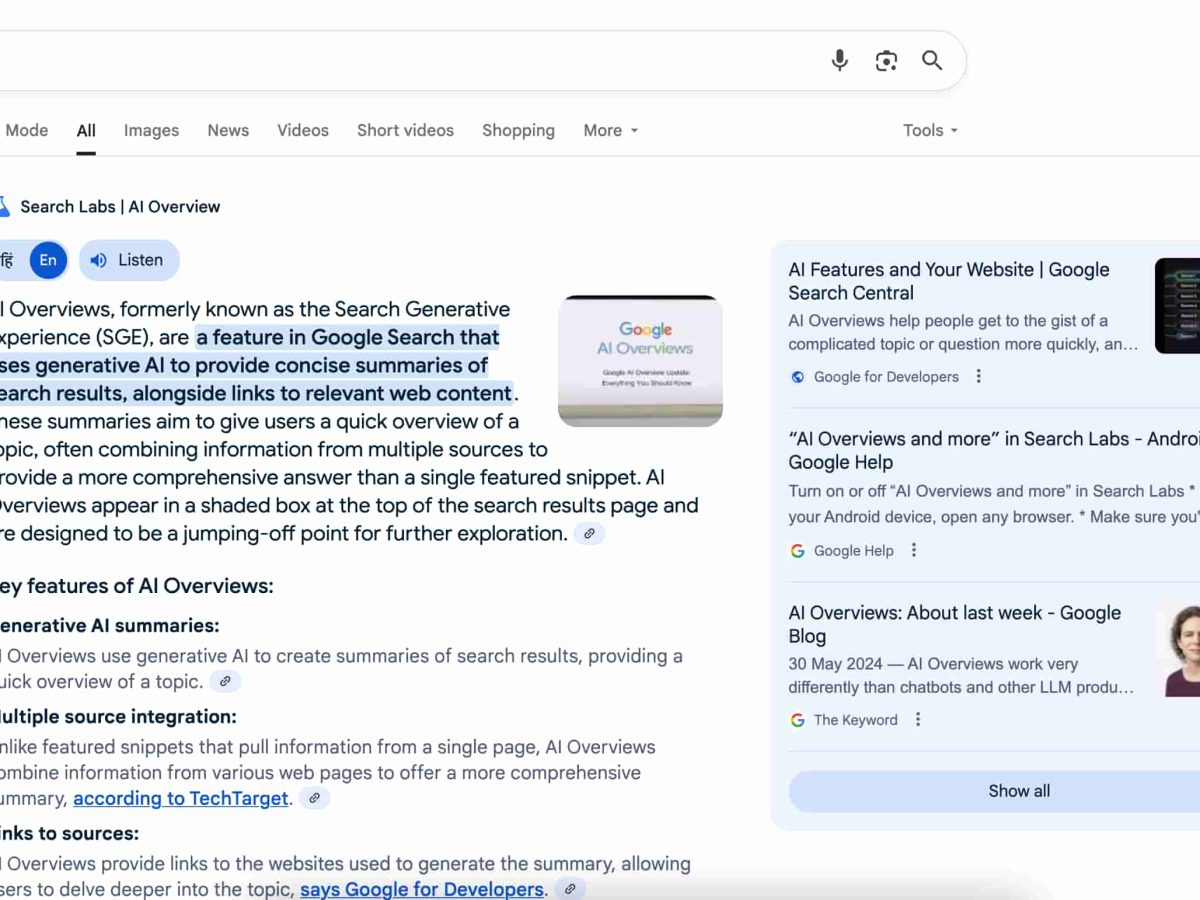

Search is changing. Google AI Overviews, ChatGPT, and Perplexity no longer rely only on traditional rankings. They pull direct answers from content they can read, parse, and trust. But here’s the truth: even great content won’t show up in AI Overviews if your page has technical issues. To help, here’s a quick, simple checklist that […]
Tag: Google AI Overviews
Google AI Overviews are AI-generated summaries that appear at the top of Google’s search results. They were first introduced in May 2024 under the name Search Generative Experience (SGE) and later rebranded as AI Overviews. These summaries provide quick, AI-written responses pulled from multiple web sources. Unlike traditional featured snippets, which quote a single source, AI Overviews combine information from various sites and display supporting links below the summary.
AI Overviews are becoming more common in search. According to recent industry data, they appeared in around 6.5% of queries in January 2025 and rose to over 20% by May. They now appear in roughly 20% of desktop searches in the U.S. and occupy a significant portion of the search results page—about 42% of the screen on desktop and nearly 48% on mobile. This increased screen space means traditional organic results are pushed lower, affecting click-through rates for websites.
Mobile users are a major part of this shift. Around 81% of queries that trigger AI Overviews come from mobile devices, with high engagement among users aged 25 to 34. Studies show that users accept the AI-generated summary more than half the time. Most of these Overviews are triggered by informational queries, especially in categories like health, science, law, and current events.
There is growing evidence that AI Overviews reduce traffic to traditional organic listings. Click-through rates for organic results drop by 30 to 35% when an Overview is shown. Some reports show that while impressions rise due to increased visibility, the actual number of clicks declines, suggesting a rise in “zero-click” search behavior.
Google reports that more than a billion users have interacted with AI Overviews. The feature is part of Google’s push to make search more useful, especially for complex queries. AI Overviews are powered by Google’s Gemini 2.5 model, combined with the Knowledge Graph and traditional ranking systems. The technology uses a method called “query fan-out,” where Google generates multiple related queries behind the scenes and combines them into a single, summarized response.
AI Overviews have not been without controversy. Early on, users reported inaccurate or misleading summaries. Google addressed these issues by improving quality checks and reducing the rollout temporarily before re-expanding the feature. User feedback has since improved, especially for advanced search needs, which has led to the introduction of an even more advanced search interface called AI Mode.
For website owners and SEO professionals, it’s important to know that there are no separate rules to appear in AI Overviews. Google has stated that existing best practices for SEO still apply. These include ensuring pages are crawlable, using structured data (like schema markup), improving page load speed, writing clear and helpful content, and optimizing for mobile devices.
As AI Overviews take up more space and attention in search, businesses and publishers must adapt. It’s no longer just about ranking well—it’s about being selected as a trusted source for AI-generated answers. This shift means that content must not only be optimized for search engines, but also be structured in a way that AI systems can easily access, understand, and use.
To stay visible in AI-driven search, brands should focus on publishing well-organized content, keeping technical SEO strong, and monitoring performance beyond just traditional rankings. As the search landscape evolves, appearing in AI Overviews may soon become just as important as appearing on the first page of Google.